Monday, 17 February 2014

SNAPSHOTS IN AN ALBUM: MEMORIES OF AN EVACUEE IN FAIRY CROSS

I was recently sent this delightful childhood account by Linda Le Merle about her stay in Fairy Cross as an evacuee in 1944, during the Second World War. These are the recollections of  her time in Bideford and in particular, the countryside Parish of Alwington and the hamlet of Ford and Fairy Cross. These are a little girl's "Snapshots in an Album" and we would love to hear from anyone who might be able to fill in the gaps or who recognises the people and places mentioned. If you do then please leave a comment here and a message for Linda.

MEMORIES OF AN EVACUEE IN FAIRY CROSS By Linda Le Merle, née Wolfinden
Strange to say, as I was starting to write a few notes on my experience as an evacuee in Fairy Cross, Devon, I came across another evacuation account written by someone who had been evacuated in 1944 as I was, and who had lived close to me and gone to my Surbiton primary school. Our evacuation began in June, around the time of my eighth birthday when the buzz bombs were droning and dropping over England, and lasted three or four months until it was thought safe to return home. My family had previously been evacuated to Dorset during the “phoney war” in late 1939, and that, too was for a short time only, before we all came back to London while the Blitz was going on – curious! In June 1944 the other evacuee and I must have set off together since all the local schoolchildren were gathered together at an army depot and given their lapel labels before being taken to the railway station, but she went to Cardiff, because, she says, “Later I heard that two trains had somehow got mixed up and in fact we should have gone to Devon.” Mine was the train which did go to Devon and so I came to spend three or four months in the beautiful countryside near Bideford. My father stayed at home in the Home Guard and I set off with my brother Philip and my mother, who was going to be a billeting officer in Bideford.  When young children ask today if we were frightened to be living through the war, I have to say that unless we had actually been bombed out or lost a member of the family, fear was not always a big problem for children – wartime was all we had known.  While our parents were often made ill by fear and stress brought on by the bombing and restrictions, it was change and uncertainty which were the real threats to children’s states of mind as they are in peacetime.  So – the journey started with some excitement, and although my mother was nearby, it was only when I was separated from her and my brother when we arrived in Bideford that I really started to understand that I would be on my own. From that point on my memories of being an evacuee are like snapshots in an album, and I’m sorry not to have any real photos to go with them. The first memory is of walking in a crocodile through the streets of Bideford. Someone – maybe an older worldly-wise child – said cynically that this was so that the good citizens of Bideford could pick out a child they liked. Whatever the truth, most of us spent the night sleeping on the floor of a community hall before being allocated our billets the next day. This was a moment of anxiety – the world would end if I couldn’t be placed with my friend Shirley Bosson.  Somehow it was managed, and somehow all the children were taken to their temporary new homes. At this point the snapshot memory changes from black and white into colour. We found ourselves arriving at the Fairy Cross cottage of Mrs Hockin – or her name might have been Mrs Hocking. There are perfumes and tastes which can transport you straight back to the place where you first experienced them, and to this day the smell of geraniums awakens the memory of when I first came across rows of pots of the scarlet flowers in Mrs Hockin’s cottage living room. From the first moment she seemed to be a kind lady, but she was already 72 years old, which must have accounted for her forgetting that children don’t usually like hot milk with the skin on top – rather a difficult welcome for two homesick girls. I remember the cottage as being cosy, with no running water or bathroom, but I have no recollection of daily routines, food or the layout of the house, apart from the fact that the WC was a privy in the back garden with squares of newspaper hanging on a butcher’s hook behind the door, and that we washed in a pretty china basin in the bedroom, pouring water out of the big matching jug.
School for those few months was in the little church hall which we reached after a short walk through country lanes. We picked sloes from the hedgerows and were free to walk on our own at all times, but this idyllic time was not without one black day. We were all deeply shocked to hear that one girl much younger than ourselves, who sometimes walked with us, had been killed in the lane, crushed between the posts of a fence round the fields and some heavy farm machinery which trundled relentlessly down the lane without seeing her.  At the school there were only two classes for all the children whose ages ranged from five to fourteen. Again, I have no recollection of the routines, except for one vivid memory of how I spent a lot of time there. I was taught to knit, and given a ball of grey string-like thread with which I was to knit a dishcloth. It took most of the time I was at the school, as I remember, because it had constantly to be undone and begun again. Whatever else I learned there, I was left with a skill which proved to be useful for a long time afterwards.
When we were not in school we were free to play in and around the village, but paths to the beach were out of bounds because the beaches themselves were defended against enemy attack. I seem to remember that from somewhere near Portledge House we must have been able to climb on high ground from where we could see the beaches and the sweep of the coast round to Hartland Point, with Lundy Island out to sea. There was a wood behind the cottage where we enjoyed playing, but one day when three of us were running through the trees we managed to kick up a bees’ nest. The first of us escaped lightly, the second – I think it was me – received a few stings, but the third was stung so badly that she had to spend a whole day in bed afterwards.  A happier way of spending our free days was scrumping from trees down the road near the main part of the village. Are there still Stripey Jacks in Fairy Cross – those little apples with red and gold stripes which we ate there in great quantities seventy years ago? Shirley Bosson’s mother came for a visit a few times and I saw my own mother occasionally, but she was kept busy going round the billets checking that the evacuees and their hosts were getting along together as well as could be expected. She herself was comfortably billeted with Mr and Mrs Cock who lived at “Glaisdale”, Abbotsham Road in Bideford, and one day she came to take me by bus to spend a night with her. I remember a genteel elderly couple, and most of all I remember the delicious creamy oatmeal we had for breakfast – very unlike the porridge I was familiar with. Mrs Edith Cock and my mother kept up a correspondence for many years, and on my bookshelves is a little book she sent me “with much love and many kind thoughts” for my 21st birthday. It is called “Character and Conduct”, and the theme for today, February 9th, is knowing how to be ready, a lesson in avoiding procrastination. Perhaps I should have looked at it more often from time to time as Mrs Cock suggested.  At this point my memories, black and white or technicolour, run out. Although we had spent happy times in Devon, I think my mother was quite relieved to take us home when the worst of the buzz-bombs period was over. My own brother, who was billeted in Barnstaple, had got into trouble one day with his friend Derek when they took their catapults out to play. We needed to get home before being accused of being London hooligans! I only once saw Mrs Hockin’s house again when we were driving by after a family holiday in the West Country. I hope it’s still there, and even if it isn’t, it’s still here among my happy memories.  
MEMORIES OF AN EVACUEE IN FAIRY CROSS - By Linda Le Merle, née Wolfinden (All rights reserved)
Explore Alwington and Fairy Cross with the North Devon Focus Picture Tour
Explore Bideford with the North Devon Focus Picture Tour
North Devon History Bytes
Alwington a Millennium Experience published by Alwington Parish Council - Visit Alwington Parish Web Site

Wednesday, 12 February 2014

A romantic gesture for Devon nature lovers

Nature lovers in Devon are giving an alternative gift this year, not content with a bunch of roses, they are opting for a whole acre of wildflowers in north Devon. Devon Wildlife Trust's Meeth Quarry; nature reserve, near Hatherleigh, is a 370-acre wildlife haven and is DWT's newest site. The Trust has given supporters the chance to Adopt an Acre  of the reserve as part of an appeal for funds to improve the recovering industrial landscape for wildlife. Of more than ninety-five acres adopted so far many were as gifts for someone special. Now on the eve of Valentine's Day the Trust is waiting to see if there's a romantic story behind the hundredth adoption of an acre. For many, adopting an acre gives them a personal connection to a wild space as well as playing a part in conserving nature in Devon. Joyce and Ernie Dignam of Barnstaple said they were "concerned that so much of our county is being covered with concrete and we believe the only way to protect diversity is to own land". Joyce added, "we would like to be able to buy a whole nature reserve for Devon Wildlife Trust but that is out of the question. The next best thing is to adopt a share of one." The Adopt an Acre package includes a map showing the location of the chosen acre as well as a certificate of adoption illustrated with the image below of Meeth Quarry at its most colourful. James Wilson in Plymouth wanted to give an acre as a gift to the people closest to him after enjoying a guided tour of the reserve at a DWT event. He says "it occurred to me that the scheme would be a great and original way of channelling the charity donations I usually make in lieu of gifts that we don't actually need. I managed to persuade the lovely team at DWT to supply me with multiple copies of the certificate and map to send to my family." The former mining and quarrying at the site created a very diverse landscape, making it ideal for conversion to a nature reserve. Dominated by two large lakes and mounds of clay spoil, Meeth Quarry also features ponds, woodland, bogs and grassland. Together these make the reserve a home for a diverse array of plants and animals including Brown Hare; Willow Tit and many species of butterflies, dragonflies and orchids. The diversity of Meeth Quarry extends to the Adopt an Acre offer, with an option to adopt an area of woodland, grassland or open water. James Wilson says "I chose a grassland acre, as I understand this is a very valuable habitat for flowers, birds and insects alike. I look forward to visiting again in the summer months to see for myself the abundance described so eloquently on our guided walk!" So, a few roses that will last a week, or a plot of flower-rich grassland that can be visited year after year? Adopt an Acre at Meeth Quarry is the romantic gesture for anyone who sees the natural world in Devon as something to love.

http://www.devonwildlifetrust.org/meeth-quarry-plans-and-how-to-adopt-an-acre/  
Photo Meeth Quarry copyright Devon Contemporary Photography 

Monday, 10 February 2014

Pebble Dash and Rainbow over the Ridge, Westward Ho!

February roared in like a lion as the UK, the South West and the North Devon Coast in particular was pounded once again by gale-force winds and thundering seas which coincided with high Spring Tides on Saturday the 1st February. The waves were so huge that sea walls cracked on the promenade at Westward Ho! and the Pebble Ridge was breached for the second time. The area behind the Pebble Ridge, known as the Northam Burrows Country Park was therefore flooded and this included the links course of the Royal North Devon Golf Club. The Slipway withstood the pounding, not so lucky was the Adventure Play Ground and Go-Kart Track which was decimated, splattered once again with marine debris and pebbles. Such was the power of the waves that the pebbles and boulders were tossed high and wide also filling in the passageway to the Southwest Coast Path section of the Burrows itself. Sunday the wind had dropped and the sun came out briefly enabling people to venture on the beach at last. Rain squalls were followed by a rainbow. It was a race against time and tide as the diggers dashed up and down the beach, scooping pebbles up from one of the Pebble Ridge and dumping them back down to repack the area which was breached just beyond the slipway. The car park and toilets were closed again but the Slipway Takeaway thankfully remained unscathed and was open for business as usual. Here is a slide show of pictures taken on the Sunday 2nd February, you can also view them on FLICKR .Article and photos 2nd February copyright Pat Adams


Monday, 27 January 2014

Crash, Bang, Wallop. Surging into the New Year

I'm hunkered down writing this while the wind is howling outside, the birds have nipped off to the safety of the hedges and the trees so it’s a good job I did the Big Garden Birdwatch Survey this morning. Crash bang wallop, what a start to the New Year. The interminable rain caused rivers to break their banks, rainbows followed the rain, there were giant hailstones and lightning strikes, landslips and land-slides and that was before the storm Hercules arrived. According to news reports there were "twenty-one severe flood warnings, the highest level, issued in the South and West with 500 alerts in total across the UK" The great Atlantic surge began at the end of December when these photos were taken down at Westward Ho! a few days later the coast was bombarded with monster waves up to 10 metres high. The huge swell wreaked havoc along the coast, thundering waves "towering" over the Renish Tower at Lynmouth, breaching sea walls at Ilfracombe and Instow and even the mighty Pebble Ridge succumbed as the pebbles were flung up off the ridge and over the car park and Go-Cart Track by the slipway at Westward Ho! Diggers were brought in to repair the damage, the car park was still closed last week. As the swirling Atlantic waves surged and unrelenting high tides crashed onto our North Devon Coast, residents, local authorities, highways agencies and emergency services have been left counting the cost. In the aftermath tons of marine debris and litter were deposited on beaches in the area and the SAS (Surfers Against Sewage) community worked together as over 400 volunteers helped at BEACH CLEAN events including Croyde and Woolacombe. It’s amazing that we never tire of watching a raging sea, people stand in wonder, children delight in racing away from the surf, photographers will risk all for that one definitive shot, even surfers are not deterred by the possibility of being caught in a rip tide. However, it’s definitely a dangerous game as you’re never quite ready for that extra big wave so quite rightly the Police and the Environment Agency have urged people to stay away from the sea and rivers at such times. Great care must still be taken while walking on coastal paths, the ground is sodden making it more possible for cliff falls. The Southwest Coast Path Association urge people to “Stay safe and away from the shoreline and cliff edges if you're out on the Coast Path!” Click here for the latest news on cliff falls and Path diversions. Article 25th January 2014 and Pictures Westward Ho! 29th December 2013 PM Adams North Devon Focus
 North Devon Focus Picture Tour
UK STORM NEWS REPORTS FROM
USEFUL LINKS

Monday, 20 January 2014

Appledore and Lundy Granite


Friday, 17 January 2014

THE DONKEYS OF CLOVELLY LAUNCH NEW NORTH DEVON FILM PROJECT

The Donkeys of Clovelly are the stars of a new short film which launches the North Devon Moving Image (NDMI) film making project. NDMI is a long term project which has been established to create and share a collection of short films examining everyday life in north Devon today and preserve them for future generations. Amanda McCormack, founder of NDMI says “I was inspired to set up the North Devon Moving Image project after watching some fascinating archive films in the North Devon Movie bus a few years ago. It occurred to me that despite the fact that most people are regularly recording video on their mobile phones, tablets and digital cameras, no one is actually preserving this valuable resource.” Amanda added “Coming up with a bright idea is just the start, the tricky bit is actually doing something about it. It takes a lot of hard work and focus to get something like this off the ground but I was delighted to find that once I said it out loud I wasn’t the only one who thought the project was a good idea. With plenty of moral support and some practical help from Jerry Bix at North Devon Plus (who guided us through the business registration) and a grant from the North Devon Coast AONB Sustainable Development Fund, we are now up and running.” Amanda wanted NDMI’s first film to be a good example of how five minutes of video can capture a moment in time while being informative, entertaining and inspirational. “Working with Sue and Bart Kelly at Clovelly Donkeys was just wonderful. We felt really privileged to be given an insight into their lives with the donkeys. They are lovely people and it goes without saying that having big cuddles with the donkeys was quite a treat!” Richard Butler, Sustainable Development Fund Chairman commented “This project is an insightful record which reflects on an iconic part of Clovelly’s rich Heritage. We were very happy to support this inaugural film project by North Devon Moving Image and hope it will be the first of many which will provide an informative record of life in North Devon.” North Devon Moving Image will be building their short film collection in a variety of ways, working with individuals, community groups and film makers in north Devon. 2014 will be a pilot year where NDMI demonstrates different creative film making styles, launches community projects and hopefully inspires other local film makers to get involved. 
To find out more you can visit the NDMI website at www.northdevonmovingimage.org.uk or catch up on twitter @NDMovingImage and Facebook North Devon Moving Image CIC.
http://www.northdevonmovingimage.org.uk/
Photos: Amanda McCormack with Sarah the Clovelly Donkey, Bart and Sue Kelly of Clovelly Donkeys
What viewers have said about the film
Colin Shaddick “A beautiful and quirky film from North Devon.”
Jos Goulding “An absolute delight … well done Sue & Bart” 
Dion Sears “I loved it! Perfect music at the start and I loved how the donkey was part of the interview and kept trying to nibble things, it must have been hard not to laugh. Hope they find someone to pass the job onto … Great stuff, what's next?”
WATCH THE FILM/LEAVE ACOMMENT ON YOUTUBE HERE: http://www.youtube.com/watch?v=MtHE0hF4szA

Friday, 10 January 2014

New Year rainbows, soggy walks. and counting birds.

I am feeling a little “under the weather” so I’m not getting much gardening done. According to the RSPB this is the best time to cut back trees or trim hedges before the mating season, which tends to start in February, so I really am eager to start. After such a turbulent start to the New Year, you’d think the birds would be quite wet enough  but this week both the male and female Blackbirds were splish-splashing in the tinfoil bath in the back garden and today a Starling was going at it like a jet skier in a water filled planter in the front garden. So by the look of it the birds  are already beginning to rouse themselves. There is a little more action also on our bird feeder and on the hedgerows and field nearby. Spotted two Buzzards today, the Starlings were enjoying the stubble on the field earlier in December and this week they have been gathering in quantity on the telephone wires  beside the A39. Last week, after the storm, we took a soggy walk on a debris strewn beach at Instow on the Torridge Estuary then moved on to a seemingly tranquil Fremington Quay where a small cluster of seabirds, an Egret and one lone Curlew were quietly drilling down in the mud. We returned via Bideford and spotted a Murmuration swooping and swirling above Bideford Long Bridge. As light was fading we parked awhile on Brunswick Wharf to enjoy the spectacle. Meanwhile back in my garden the Chaffinch, Great Tits, Coal Tits and Sparrows are constant visitors, Mr. Robin is already stating his claim with an occasional song, and the Blue Tits continue to sneak nuts out from under the beaks of our resident Doves which plonk themselves on the feeder. Rainy days have been lit up by rainbows after some short bursts of sunshine. The only down side to this perfect little scenario is a local ginger cat that languishes below the feeder and waits.... What’s the betting that all this action disappears when it’s time for the Big Garden Birdwatch which this year is over the weekend of 25th and 26th January
A little under the weather and ragged round the edges, just like me
The first rainbow of 2014
Lone Curlew off Fremington Quay
Count the wildlife that's counting on you. Bird populations are a great indicator of the health of the countryside. That's why it's so important to take part in surveys like the Big Garden Birdwatch to keep an eye on the ups and downs of the wildlife where we live.  All you need to do is spend an hour over the weekend of 25-26 January counting the birds in your garden. It's that simple! The more people involved, the more we can learn. So, grab a cuppa and together we can all help to give nature a home. For more info and to register, please visit www.rspb.org.uk/birdwatch

Tuesday, 7 January 2014

Artist finds his muse in former clay quarry

A Westcountry artist has been appointed to the position of 'Artist in Residence' at one of the region's largest nature reserves. Peter Baker moved to the north Devon village of Meeth just two years ago. As a life-long artist, Peter soon found himself searching for a new local muse - to act as a focus for his painting and artistic expression. So when Devon Wildlife Trust bought the 150 hectares of Meeth Quarry in 2012, opening the site as a nature reserve in May 2013, he was delighted to find that this inspiration actually existed right at the bottom of his garden. Devon Wildlife Trust's work over the past year improving the former clay quarry (production ended in 2004) as a place for people and wildlife has provided Peter with a focus for his art. The tracks, paths, woodlands and lakes of the new nature reserve have given Peter a huge new outdoor studio. The nature reserve is now providing the stimulus for a series of works in pen and ink and some watercolour studies. Peter's approach means he often spends hours each day exploring and sketching the reserve. He spoke of his fascination for Meeth Quarry: "'When I moved to the lovely village of Meeth I had no idea that my wife and I were going to be living next to the Tarka Trail and the new Meeth Quarry nature reserve. Peter continued: "The 'mood' of the reserve changes with the weather and the season giving endless inspiration to any painter. Being a marine artist I have had to change my style and method of working, you don't find many trees growing on beaches, but I find this unique challenge exciting and I am looking at nature with young eyes. I hope that my recent artwork will illustrate my curiosity and pure pleasure in depicting my new surroundings." Meeth Quarry is one of 48 nature reserves owned by the charity Devon Wildlife Trust. Tamasine Addie, Community Outreach Officer for the Trust's Northern Devon Nature Improvement Area project, said: "Peter's work is wonderful. It beautifully captures the spirit and wild atmosphere of Meeth Quarry nature reserve. It's just the kind of connection we hoped people in the local community would make with this place. Peter's art may be one man's vision of the reserve, however it's a vision that he very much wants to share. We think his work will really help people see the landscape at Meeth Quarry and appreciate it in a different way. It may even encourage people's own artistic responses to this wonderful place." Tamasine continued: "Peter is working on the first of what we hope will be a series of paintings and studies that showcase elements of the nature reserve in a new light. When complete, we plan to make these accessible with, perhaps, a local show of work or may be even on the nature reserve itself." At the moment you can see a selection of Peter Baker's pen and wash depictions of Meeth nature reserve at the Society of Graphic Fine Art's website www.sgfa.org.uk or see them at the Northern Devon Nature Improvement Area website, www.northerndevonnia.org where you can also find out more about the NIA project and its links with local communities. 

'Meeth Quarry Works' - (Image copyright Peter Baker , all rights reserved)
'Autumn' -  (Image copyright Peter Baker , all rights reserved)

Tuesday, 17 December 2013

Merry Christmas and a Happy New Year

Hi there, I would just like to wish you all a very Merry Christmas and would also like to thank you all for visiting and supporting the North Devon Focus Coast and Country Chronicle site this year. I do hope you have enjoyed the news, photographs and posts. I love North Devon, it's events, towns and villages and of course the wonderful local flora and fauna. I hope my photographs capture the beauty and diversity of the area throughout the seasons. After promoting North Devon in one way or another for nearly thirty years, I now just take photographs and blog for fun but no matter what time of year, whatever the weather there is always something to see and enjoy in the Bideford Bay Area. The last of the Christmas Fairs, Markets and Fun Days are on Saturday 21st December. Be sure not to miss the last day of Bideford Winter Fairs, Saturday 21st Dec from 10.00am at the historic Pannier Market.There will be lots of family friendly fun including some festive antics from the 'Entertainingly Different' gang. There is also a Farmers' Market at Jubilee Square, Bideford from 9-1am and of course The Big Sheep at Abbotsham are also holding the last of their Christmas Farmers Markets. Just a reminder that the last Quince Honey Farm Christmas Fun Day in South Molton is also on the 21st. Click here for Local Church Services and Events
http://www.thenorthdevonfocus.co.uk
Promoting the Coast and "Country" Side of Bideford Bay since 2002
Join Us on Flickr
Join Us on Facebook

Thursday, 5 December 2013

Free rural training events for managers of land in the River Torridge Catchment Area

Free rural training events launched Landowners and farmers who manage land in the river Torridge catchment in north Devon are being offered the chance to take part in a series of training workshops and demonstration events during the coming winter months. The subjects being tackled cover critical farming tasks including woodland and soil management. The workshops and demonstrations are free to attend and form part of the work of Northern Devon Nature Improvement Area (NIA). The project is striving to improve the local landscape for people and nature through restoring, expanding and joining up wildlife-rich areas. It covers 72,000 hectares in the river Torridge catchment. It is one of 12 partnership projects which were created a year ago following a competitive bidding process for a share of £7.5million new funding from the Department for Environment, Food and Rural Affairs (Defra) and Natural England. Since its beginnings in 2012 the Northern Devon NIA has worked with over 200 local landowners and farmers. Its project manager Lisa Schneidau explained why the training events were being organised: "Many landowners in the Torridge catchment are already doing a great deal for wildlife, whether it's managing Culm grassland, laying hedgerows or planting woodland. These events help us to bring together local experts and people with experience of land management techniques and challenges, and share knowledge on how different issues can be practically tackled - for the benefit of those already doing wildlife work, and those landowners who would like to do more." The landscape management events are being staged at venues across north Devon over the coming weeks - some indoors and some out on site. They are free to attend, refreshments will be provided but places are limited.  
Landowners and managers who are interested in attending should book a place by contacting the Northern Devon NIA's offices in Cookworthy, near Holsworthy on 01409 221823 or email info@northerndevonnia.org 
The training events and demonstrations include:
  • Weds 11 December 'Woodland planting best practice for landowners', 10am at Cookworthy 
  • Thurs 9 January - 'Woodland planting best practice for contractors', 10am at Cookworthy 
  • Tues 14 January - 'Soils and soil management', 10am at Cookworthy 
  • Thurs 22 January - 'The economics and value of woodlands and firewood', 7pm at Hatherleigh 
  • Wednesday 5 February - 'Hedge management and woodfuel', 10am at Cookworthy 
  • Thursday 6 February - 'An introduction to hedgelaying techniques', 9.30am at East Putford 
  • Wednesday 12 February - 'Woodfuel and woodland access', 10am at Shebbear 
  • Wednesday 26 February - 'Squirrel control and woodland management', 10am at Halwill 
  • Wednesday 19 March - 'Managing woodlands for wildlife', 10am at Peters Marland 
The Northern Devon NIA project team is also planning to stage a series of swailing workshops this winter. Swailing is the controlled burning of grasslands. It provides a traditional and effective way of renewing rough pasture, especially the Culm grasslands for which north Devon is especially renowned. Swailing requires dry weather - something which is not always predictable in north Devon! The project team is therefore asking potential participants to provide them with their contact details. Then when weather permits the team will issue a 'call-out' with details of where and when swailing workshops will take place.  
Up to date details regarding all training opportunities provided by Northern Devon NIA can be found at www.northerndevonnia.org

http://www.devonwildlifetrust.org/

Wednesday, 4 December 2013

Winter Sports and more at the Big Sheep. Snowboarding Simulator, Toboggan Slope and Ice Rink

The Big Sheep will be adding a big Wow Factor to Winter from this weekend. You can enjoy the toboggan slope for children and adults and get into the wintery spirit racing at high speeds from the top to the bottom of the slopes! You can be sure that your woolly hats, scarves and gloves will be coming off as you warm up from running back up to the top of the slope for numerous rides! Alongside the new toboggan slope will be the synthetic skating rink, back again for you to practice your skating skills. Toddlers can also have a go at skating with their new ski boots suitable for small children. NEW for this winter season will be their new snowboarding simulator. All winter activities are undercover in the new events building. Christmas Farmers Markets will be held on the run up to Christmas on the 7th, 14th and 21st December, there is also a Gingerbread Workshop on the 21st December and Breakfast with Santa on the 22nd December.  Visit web site to book tickets or find out more
http://www.thebigsheep.co.uk/
Christmas Farmers Markets - Please click here to view the full stall holders list

Friday, 29 November 2013

What's the buzz in South Molton. Christmas fun days at Quince Honey Farm

There is a bit of a buzz in South Molton about the Christmas fun days at Quince Honey Farm when you can take part in Christmas festivities on the run up to Christmas. The Christmas Fun Days will be held on Saturday the 7th, 14th and the 21st December. Members will receive FREE ENTRY or only £3.95 for children and free for adults. Visit Santa in his grotto (£2.50 each including a gift) and post your Christmas wish list, there will be many Christmassy games and activities on offer with the chance to win prizes. As always children can buzz around in the play area while you can relax with a warm drink. We will be cooking up some Festive treats to get you in the mood and the shop will be open to purchase some last minute Christmas presents.
http://www.quincehoney.co.uk/christmas/

Wednesday, 20 November 2013

Catcing the Essence of Clovelly

Fishwives, fishy treats, fun and more than a splash of local colour down at Clovelly Harbour on a fair day in November. This is the month for the annual Clovelly Herring Festival, a time to celebrate the history and heritage of the humble herring, a time for visitors to meet the villagers who make and are the mainstay of this historic village. Local crafts and produce was the order of the day and an opportunity for folk to try those healthy herrings. We really enjoyed the oaty-coated herrings, freshly caught on the Perham line and pan-fried  in front of us. There were also platters of lobster and crab, tarts and quiche, smoked fish, fresh herrings, smoked herrings, marinated herring, locally sourced fish spiced with a myriad of flavours from around the world, homemade fudge, fresh baked bread and locally brewed beer. The Fishwives, a comical sight, with their rotund behinds and huge feet waddled amongst the crowds, along the Quay, their huge skirts swaying in time to the music. In addition to the Quay kitchens and cookery demonstrations, this is a time when villagers turn their hand to fundraising for local causes. The ladies from the Clovelly Community Garden Group had a stall up on the Kiln and Cream Teas were also served in the Lifeboathouse in aid of the RNLI. A couple of Clovelly yummy mummies had a homemade cake stall on the Quay, delicious sponges, fruit cakes and cupcakes raising funds for the  local “Small School”. The cupcakes decorated in sea blue fishy style with the help of little.Frida. The RSPB also had “A Stall for Nature” and the North Devon National Trust provided crafty activities for the kids up on the Kiln. Exhibitions and demonstrations of old seafaring skills and the History of Herrings and Flax Making came from Mike Smylie’s Kipperland and Simon and Ann from Flaxland. As the tide crept slowly into the harbour a Coracle, was launched by Simon who paddled quietly between a fishing boat used today and a Picarooner, one of the old traditional herring boats. I ventured along the top of the Harbour wall to capture a different perspective and noticed the Herring Gulls mobbing the lone fishing boat, a turbulent scene on a ultra calm sea. Herrings and heritage are the essence of Clovelly  I hope I have captured that in my video clip and the photos from the day. Shanty Singers “Shake a leg” can be heard in the background  - “Ten thousand miles away. Blow the wind high-ho”

Meanwhile on the other side the hub-bub on the busy Quay
SHANTY SINGERS
EXHIBITION & DEMONSTRATIONS
Clovelly Herring Festival 17th November 2013 - Article, video/photos copyright Pat Adams

Tuesday, 12 November 2013

Festive offers, music and mouth-watering delights at the next Ruby Country Market.

The traditional style Ruby Country Market at Hatherleigh began in Easter 2012 and has quickly become established as one of Devon's biggest community markets. This is an exciting event designed to showcase local businesses, a social event that brings together buyers and sellers from a wide area. Organisers and stallholders are now looking forward to welcoming visitors to the second Festive Ruby Country Market which will be held on Saturday the 7th December from 9am-2pm. You can browse and shop from around 200 stalls packed full of festive offers and be tempted by mouth-watering delights in the Food Hall. Entertainment will also be available throughout the day from such talented local musicians as:
  • The Hatherleigh Silver Band, 
  • The Hatherleigh Ukulele Bashers, 
  • The Unity Gospel Choir
  • Shebbear College Choir,
  • Josie Lloyd
  • Carnivala. 
Tickets will be on sale for a Bumper Food Hall Raffle in aid of the Devon Air Ambulance trust and several local charities will be represented. For full details of who is stalling and more information please visit www.rubycountrymarket.co.uk or phone 07855187364
http://www.rubycountrymarket.co.uk/.

Wednesday, 6 November 2013

ALL WASHED UP

North Devon faired reasonably well in the wake of the St. Jude’s Storm which swept over the UK overnight on the 27th October. Almost 30 metres of rain fell in Devon with up to 75mph winds. Nearly 1inch of rain fell in neighbouring Bude and there was localised flooding and fallen trees. Meanwhile on the North Devon Coast up to a 10ft surf was predicted sending photographers and storm watchers racing to the coast to capture the waves. This was followed by another stormy night on the 3rd November with exceptionally high tides rolling in under a full moon.  The wind had subsided the following day for our walk down to the beach, but there was a definite chill in the air. Amazingly the old trees in the wooded valley had survived. We were looking for Autumn colour but apart from the burnished bracken there was more leaf fall than leaf turn. Down at the beach the colossal Atlantic rollers had tossed a huge tree branch clear of the pebbles blocking the path at the entrance  to the beach. A wooden pallet and piles of bleached driftwood were scattered on the tideline beneath the cliffs to the left around the bend towards Clovelly and right towards Portledge and beyond. Amongst the driftwood there were, thankfully, just a few bits of plastic debris, a sign of the times. I thought it ironic that the largest item was a plastic bottle entitled “Biological Toilet Cleaner”.Article & Photos copyright P. Adams 4/11/2013
http://www.thenorthdevonfocus.co.uk 
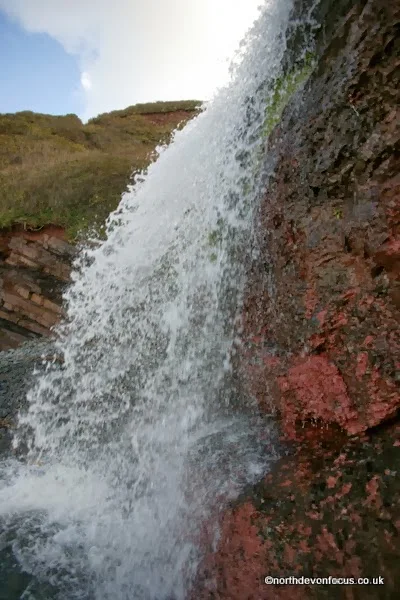
 After the rains, the waterfall  always looks more dramatic.  Photo copyright B. Adams
http://www.thenorthdevonfocus.co.uk

Get involved - How you can help protect our waves, oceans & beaches

North Devon Will Remember

The Royal British Legion is recognised as the national custodian of Remembrance. Remembrance Sunday, the second Sunday in November, is the day traditionally put aside to remember all those who have given their lives for the peace and freedom we enjoy today.

REMEMBRANCE DAY EVENTS AROUND THE REGION (Sunday 10th November) Please visit the North Devon Gazette for more Remembrance Week events

BARNSTAPLE - Remembrance Service at Rock Park War Memorial 10.50am, followed by parade to the Parish Church for a full service. The Guildhall will be open from 9.45am to 12 noon for those who wish to see the names of the fallen in World War II, and those from HMS Stevenstone, and pay their respects.
BRAUNTON - Civic Service of Remembrance, St Brannock’s Church, Braunton, 11am. Parade leaves Caen car park 10.20am.
BIDEFORD - Act of Remembrance Victoria Park 10.50am, followed by parade to St Mary’s Parish Church for Remembrance Day Civic Service 11.15am.
COMBE MARTIN - Parade leaves village coach park (Pack O’ Cards) 9.55am for Parish Church, Service of Remembrance 10.15am, Act of Remembrance at war memorial 10.50am, all welcome.
ILFRACOMBE - Remembrance Service at Holy Trinity Church and war memorial, 10.30am.

http://branches.britishlegion.org.uk/branches/bideford
    Remembrance Day (also known as Poppy Day or Armistice Day) is a memorial day observed in Commonwealth countries since the end of World War I to remember the members of their armed forces who have died in the line of duty. This day, or alternative dates, are also recognised as special days for war remembrances in many non-Commonwealth countries. Remembrance Day is observed on 11 November to recall the end of hostilities of World War I on that date in 1918.(Wikipedia)

    Tuesday, 5 November 2013

    Wildlife Trust's new App leads people to nature

    Heading out this weekend and want new places to experience autumn's wildlife spectacles? Or perhaps you just want to discover nature on your doorstep... With Nature Finder, The Wildlife Trusts' new free iPhone app, you will have a fabulous guide to thousands of nature reserves and wildlife across the UK. If you're looking for a day out and wondering where to go or what to do, look no further. Nature Finder, the simple location-based app, enables the user to find Wildlife Trust nature reserves and events wherever their current location. The app uses GPS technology to automatically find the user's location and display maps and listings of Wildlife Trust nature reserves and events nearby. Each nature reserve has an image, brief description, and information on facilities, such as parking, toilets etc. Announcing the launch of the app Devon Wildlife Trust's Steve Hussey said, 'If you're looking for a day out and wondering where to go or what to do, look no further. Visit glorious woodlands, beautiful wetlands and inspiring coastline - wander through wild countryside, discover secret inner city wildlife havens and enjoy family events from bat nights to fungal forays and children's nature activities.' The Wildlife Trusts care for more than 2,300 of some of the most beautiful wild places in the UK - landscapes that not only look gorgeous but are all the more precious because they are carefully managed to ensure that wild plants and species can thrive. In the South West the Wildlife Trust's care for some of the region's most iconic landscapes including wild coastlines, heather covered Dartmoor tors and tumbling rivers. 'This app represents a great way of accessing the South West's best nature reserves', said Steve Hussey. 'Using it will unlock walks along the River Teign at Dunsford Woods nature reserve, adventures across the wild countryside of Marsland nature reserve near Hartland, and a chance to explore the beautiful heathlands of East Devon at Bystock nature reserve. These and other wildlife havens are there to be explored and they are all free to enter.'

    Fantastic features of Nature Finder, which is free, include:
    • Searching more than 2,000 Wildlife Trust nature reserves  Information on more than 800 UK wildlife species, with the ability to favourite * Searching for nature events and activities
    • A directory for all 47 Wildlife Trusts with contact details and ability to donate by text
    • Saving your favourite places - where you've been and where you'd like to go 
    Nature Finder, suitable for all iPhone and iPad models, is available from the App Store - just search for 'Wildlife Trusts'. http://www.wildlifetrusts.org/app
    Photo copyright Tom Marshall

    Thursday, 31 October 2013

    Focus Nature Notes. Don't Tidy up Mrs. Tiggy

    Well  I was doing my bit for nature, leaving the hedge-trimming, pruning and tidying up until later so not to disturb the nesting birds. My garden, I am proud to say, is quite small, rather untidy, a tangle of climbers, overgrown shrubs and not so pristine lawns but this also makes it very wild-life friendly. Last  week I finally started cutting back the hedges, the flowering shrubs, honeysuckle and roses and generally tidying up. I started by adding an extension to my Critter Hotel  with an old up-turned wicker cat basket thinking it might be a cosy winter shelter for our resident hedgehogs. I must say I was very happy with the result, I was “Giving Nature a Home”, a veritable palace built out of cut down cable hose, logs and evergreen  branches. I was also emptying the compost bins spreading it around the flower beds and the base of the shrubs for the Blackbirds and Robins to rummage through. I eventually worked my way to the messiest corner of the garden where unused pots and trays have lain undisturbed for a couple of years. I lifted up some corrugated plastic sheeting and Noooooooo- in the far corner curled up like a hairy caterpillar was a sleeping hedgehog.  She was in the perfect place beneath the Beech trees, nestled in a leafy mattress with easy access to the path for her nightly forages in the garden. I immediately put the sheet back, sprinkled with leaves, hoping that I hadn’t disturbed her, feeling so guilty wondering if she was already hibernating or just having an afternoon nap. So the moral of the story is nature will find a home in the unlikeliest places, in messy pots, clumps of twigs and leafy litter. The beginning of November is when hedgehogs normally settle down for  the winter and as Guy Fawkes Night approaches this is a time to be extra vigilant. Devon Wildlife Trust advise leaving bonfire building as late as possible. Our hedgehogs have been in the garden for years but I have never known where their home is, I also didn’t know that they will usually wake and forage more than once through the winter so I will continue to leave a few nuts by the door on warmer nights.Article and Photo Pat Adams 1/11/2013

    Thursday, 17 October 2013

    The Factory goes Boom

    The Factory venue has teamed up with Boom Artists-a spin-off from the UK's fastest growing festival Boomtown Fair, and they have been busy programming a season of cutting edge music events that are set to change the face of live music for the local area. This first series of events is called Saturday Night Live and they run from October through to December. You are invited to experience quality live Ska, Reggae, Dub, Funk and Hip Hop through The Factory's state of the art sound and lighting rigs. Make way for headliners Babyhead, The Skints and Dr Meaker, plus legendary DJ Ed Solo is coming to play out the season's finale. Featuring alongside these established artists are handpicked rising stars from across the South West, all bringing their unique sounds and styles to The Factory. Please check out Skata Tones, The Dead Betas, Jamie Mead, Shire Roots and Blazenstein, Cut Capers, The ASBO Disco and DJ Wonka. The Factory will also be running competitions for acts who want to join some of these line-ups and news of these will be appearing on 'The Factory Petroc' Facebook page.

    Monday, 7 October 2013

    River restoration making a splash!

    A project which aims to improve the water quality and wildlife of a Westcountry river has made a splash in East Devon. The project is a joint initiative between Devon Wildlife Trust and the Sid Vale Association. It is based on a six mile stretch (plus tributaries ) of the beautiful and popular River Sid upstream from Sidmouth. Devon Wildlife Trust's Scott West is leading the project: 'Many people know and love the River Sid. It's somewhere that local communities walk, play and live beside. It's also a key component of what brings tourists to this wonderful part of the world. What the project is aiming to do is to ensure that the river remains as a special place for and people and wildlife. That means looking after its water quality and making sure that it can continue to support a wide diversity of life.' After six months of the project Scott has certainly got to know the river intimately having achieved an impressive amount of work which has included:
    • Walking the entire length of the river and its main tributaries , not using its banks but actually in the river in waders! 
    • Taking surveys of invertebrate life (typically mayflies and waterbugs) from along the river as a means of evaluating its water quality status. 
    • Conducting a series of 'electro-fishing' surveys of the river - whereby fish are temporarily immobilised by an electric current (this is only done under consent by the Environment Agency). 
    • Consulting with and advising ten local major landowners regarding land management and its impact on the river 
    Scott underlined the project's potential 'It's also an opportunity to see how positive management on the Sid can lead to healthier rivers not just here but across East Devon. We plan to take the lessons learned on this one small river catchment working with local landowners and enhancing riverside habitats and then apply them to other rivers.' The River Sid already supports an amazing amount of wildlife including such iconic species as kingfishers, otters, brown trout and damselflies, but Scott believes it could to support more. Scott said, 'This river has the potential to support other well-known but threatened species, perhaps the best example would be migrating Atlantic salmon. This river and other rivers like it would once have contained good numbers of salmon. Local people recall seeing them in years past. Our ambition is that the Sid and its neighbouring rivers might one day support species like this again.' The project is not only targeting the lives of the rivers wildlife, instead it is also engaging local communities through an ambitious education programme. Devon Wildlife Trust's Education Officer Paul Martin has been working with two local schools - Sidbury Primary and Sidmouth Primary - on a series of 'river days'. Paul explained: 'On river days we take groups of local children out to the River Sid. We assign them stretches of the river and ask them to explore them recording the wildlife that they find. The idea behind the visits is to get the children more familiar with their local river, to appreciate its beauty and to learn about the wonderful life it supports. The children certainly seemed to have enjoyed the experience!' The project's encouraging start bodes well for its next phase. Scott West explained, 'These initial months have been about understanding the river, its wildlife and the pressures upon it. It's also been about recognising the potential areas in which good local management can make a really positive impact. The next steps are threefold. First, to offer clear advice to local landowners on how they can play their part. Second, to address some of the physical barriers which face migrating fish, so for example introducing fish passes (ladders or pools) to help them overcome weirs. And lastly, to restore habitats along the river's banks - one special area we hope to tackle is the introduction of fencing to prevent cattle from entering the river.' 
    
    
    Photo: Kingfishers are just one of the species being helped on the River
    Sid. Copyright Chris Root

    Monday, 23 September 2013

    Reptile restoration work making a difference

    A leading South West charity is working hard to improve the lot of the region's reptiles and amphibians. Species including adders and common frogs, slow worms and toads may not always enjoy the best public profile but, says Devon Wildlife Trust, they are a vital part of our wildlife and one which faces an uncertain future. Over the past 18 months The Trust has set about improving several of its own nature reserves specifically to cater for the needs of these special animals. Thanks to generous funding from Biffa Award - a multi-million pound fund which awards grants to community and environmental projects across the UK - work involving Devon Wildlife Trust and its volunteers has been taking place at the charity's land at Bovey Heathfield and Chudleigh Knighton Heath nature reserves (both close to Bovey Tracey), and Lickham Common and Ashculm Turbary nature reserves in the Blackdown Hills. Devon Wildlife Trust's Steve Hussey commented: 'We are concentrating our efforts on reserves where we know there are existing populations of amphibians and reptiles. What we've been doing is ensuring that we can offer them tip-top conditions in which to flourish.' 

    The work for reptiles and amphibians has included: 
    • Digging two new ponds, while improving seven others. The ponds are providing homes and breeding places for amphibians including frogs, toads and newts, as well as hunting places for grass snakes. 
    • The installation of ten artificial hibernation (known as 'hibernaculum') nests to allow reptiles including sand lizards, adders and grass snakes to survive the cold winter weather. 
    • The construction using decomposing plant material of three heaps which provide egg laying places for grass snakes.
    • Bracken clearance and scrub removal at each of the four nature reserves designed at checking the spread of plants which threaten to shade out areas used by reptiles to bask in. 
    The effectiveness of the project is being monitored through a series of surveys. These surveys should provide an accurate picture of the distribution of reptiles and amphibians on the four nature reserves, as well as revealing how effective the work has been in encouraging rises in their numbers. Steve Hussey commented: 'It's still quite early in the project to draw firm conclusions about how much difference we are making, but the signs are encouraging. At Bovey Heathfield nature reserve, for example, one recent survey revealed large numbers of smooth newts in a pond which had been re-dug by the project team.' Steve continued: 'The winter ahead will see further work done for reptiles and amphibians on Devon Wildlife Trust nature reserves. We're delighted that funding from Biffa Award is allowing us to make a positive difference to such well-known but struggling species as adders and toads.'
    Photo: Common Lizard copyright Chris Root
     

    Thursday, 19 September 2013

    Charity receives vital backing for Dartmoor project

    Leading conservation charity Devon Wildlife Trust is celebrating the news that it has received a £38,000 funding boost from SITA Trust to support its Emsworthy Mire Restoration Project. Emsworthy Mire forms part of Devon Wildlife Trust's beautiful Emsworthy nature reserve. The reserve sits between Haytor and Widecombe-in the-Moor, in the heart of Dartmoor. It is a very popular spot with walkers and other visitors. Emsworthy's Mire is a particularly good example of a valley mire: areas of water-logged deep peat in valley bottoms with characteristic acid wetland plant communities. The valley mires on Dartmoor, including Emsworthy's, are of international importance to wildlife and are of high quality with many rare plants. Devon Wildlife Trust's Steve Hussey said: 'Emsworthy's mire is especially rich in wildlife. Some of the characteristic plant species which are supported there are bog asphodel, round-leaved sundew, pale butterwort, bog bean, cotton grass and marsh lousewort. In summer, the mire is home to many dragonflies and other insects including keeled skimmers and the rare marsh fritillary butterfly. In winter, it is wading birds such as snipe and golden plover that visitors will see.' However, the mire and its plant and animal communities are at risk because it borders semi-natural grassland and open moorland grazed by livestock. Stone walls and fence boundaries which once kept livestock well away from the mire have fallen into disrepair and this has led to the site being over-grazed and its condition has deteriorated. Now, funding from SITA Trust will allow Devon Wildlife Trust to restore the valley mire. Specifically it will allow: 
    • Re-building and repair of the historically important dry stone walls between the mire and surrounding fields 
    • Installation of new fencing along the mire's other boundaries 
    • Control of encroaching scrub woodland 
    Steve Hussey added: 'These works will allow grazing levels in the mire to be fully controlled so that the sensitive wetland plants can recover. It will also allow us to promote the growth and spread of the plant Devil's-bit scabious which supports two of the nature reserve's rarest inhabitants, the marsh fritillary and the narrow-bordered bee hawkmoth.' Marek Gordon CEO and Chairman of SITA Trust added 'We are delighted to have been able to support this project through the Landfill Communities Fund. This important source of funding has been available since 1997 and has provided such worthy projects with more than £1.2 billion.' SITA Trust provides funding through the Landfill Communities Fund. Funding is available for projects that enhance communities and enrich nature.

     'Devon Wildlife Trust's beautiful Emsworthy nature reserve on Dartmoor is set to see a make-over' - Photo copyright Simon Williams. 

    Monday, 16 September 2013

    B10 LECTURE SERIES: THE FUTURE OF THE BIOSPHERE, WEDNESDAY EVENINGS FROM 16 OCTOBER TO 27 NOVEMBER 2013

    To celebrate ten years of north Devon’s Biosphere Reserve a series of lectures will take place looking to its future. Each lecture will focus on different features of the Biosphere and will be delivered by an expert in that particular field. Full details below:

    THE FUTURE OF THE CLIMATE Dr Matt Palmer, Wednesday 16 October 2013 - 8.15 pm, Bideford College Abbotsham Road Bideford Devon EX39 3AR
    The Future of the Climate  - Dr. Matt Palmer leads sea level research at the Met Office. His research focuses on how the oceans and wider climate system will shape future sea level rise - both globally and regionally. The Future of Climate: Human-induced climate change is now widely accepted, but how will it affect us? We will review the current knowledge and explore some of the changes we can expect to see over the coming decades.
    THE FUTURE OF FARMING  - Prof Michael Winter, Wednesday 23 October 2013 - 8.15 pm, Bideford College, Abbotsham Road, Bideford, Devon EX39 3AR
    The Future of Farming - Michael Winter chairs the Biosphere Partnership. He is Co-Director of the Centre for Rural Policy Research at the University of Exeter and Director of the Food Security & Land Research Alliance (a joint initiative of the universities of Bath, Bristol and Exeter and Rothamsted Research). Michael’s research work has been funded by UK research councils, Defra, environmental agencies, charitable trusts, and local and regional authorities. He has published many research papers, books and reports. He is a past Countryside Agency and Commission for Rural Communities board member and is currently a member of the National Ecosystem Assessment Expert Panel. The Future of Farming: This lecture will examine the factors – physical, economic, social, political – that shape the distinctive farming of the Biosphere. What is the future for agriculture in this part of Devon? Will the global food security priority find expression in greater emphasis on production or will environmental considerations and concerns predominate? What will be the role of local food or organic production? And socially, will more or still less people be involved in farming in the future and will the traditional family farm survive?
    THE FUTURE OF CULM GRASSLANDS  Dr Philip Murray, Wednesday 30 October 2013 - 8.15 pm Okehampton College, Mill Road, Okehampton, EX20 1PW
    The Future of Culm Grasslands - Dr Phil Murray is Head of the North Wyke Campus and Associate Head of the Sustainable Soils and Grassland Systems Department of Rothamsted Research. North Wyke is the foremost grassland research station in England and is the home of the North Wyke Farm Platform, a major investment in research infrastructure by the Biotechnology and Biological Sciences Research Council that aims to better understand and develop sustainable grassland systems. The Future of Culm Grasslands: In his talk Phil will explore the future of culm grasslands and how the underpinning research is helping us to develop sustainable grasslands in the South West.
    THE FUTURE OF LANDSCAPE - Prof Peter Howard, Wednesday 6 November 2013 - 8.15 pm, The Plough Arts Centre, 9-11 Fore St, Great Torrington, Devon, EX38 8H
    The Future of Landscape - Peter Howard is a member of the Biosphere Partnership, and a Visiting Professor of Cultural Landscape at Bournemouth University. He works closely with the Council of Europe and the European Landscape Convention, and has recently published An Introduction to Landscape (Ashgate) and has co-edited the Routledge Companion to Landscape Studies. The Future of Landscape: The coming into force of the European Landscape Convention urging the participation of all in landscape matters, and the importance of ordinary landscapes, inevitably produces clashes, not least with the renewable energy industry. Whose landscape will it become?
    MARINE FUTURES - Dr Simon Ingram Wednesday 13 November 2013 - 8.15 pm, The Plough Arts Centre, 9-11 Fore St, Great Torrington, Devon, EX38 8HQ
    Marine Futures - Dr Simon Ingram is a Lecturer in Marine Conservation at Plymouth University and Associate Editor for the journal Biodiversity and Conservation. His PhD research, at Cork, was concerned with the conservation of bottlenose dolphins, and he has worked with cetaceans and seals in many waters. His current research project is based in Lundy. Marine Futures: His talk will look at current conservation issues concerning marine life, and the future for the health and biodiversity of waters around the UK.
    ENVIRONMENTAL SECURITY - Dr Mike Moser, Wednesday 20 November 2013 - 8.15 pm, The Plough Arts Centre, 9-11 Fore St, Great Torrington, Devon EX38 8HQ
    Environmental Security - Mike Moser chaired North Devon’s Biosphere Reserve Partnership from 2008-12, and now chairs the Northern Devon Nature Improvement Area steering group. He manages a 75 acre farm near Chulmleigh which includes a woodland County Wildlife Site. Mike also works as an international specialist on ecosystem management, and has advised long term projects of the United Nations Development Programme and Global Environment Facility in Iran and the Maldives, as well as many other international initiatives. He was formerly Director of the NGO Wetlands International, and Acting Chair of English Nature. Environmental Security: In his talk, Mike will explore how an ecosystem approach to managing land, water and the seas in north Devon can enhance our environmental security, and explore what lessons we can learn from other Biosphere Reserves.
    ENVIRONMENTAL CAREERS - Dr Eirene Williams, Wednesday 27 November 2013 - 8.15 pm, Okehampton College, Mill Road, Okehampton, EX20 1PW
    Environmental Careers - Dr Eirene Williams was a Principal Lecturer in Rural Resource Management at Seale-Hayne College. She started her career in Malawi and returned to buy a farm in South Devon and taking up various teaching and research posts around Exeter. Eirene now teaches part-time at Duchy College, and is a Governor of Petroc. She also took on the chairmanship of Devon FWAG and the Vice-Presidency of the Institute of Ecology and Environmental Management (IEEM) and consequent place on the Board of the Society for the Environment. Her recent work for IEEM contributed to it being granted Chartered status in 2012. Eirene was born and brought up in North Devon and has returned to live in what is now the Biosphere Reserve. Environmental Careers: Eirene’s talk will explore the many and various opportunities for working in the environmental sector and the qualifications and qualities required in these careers, with special emphasis on those that are likely to be available in Northern Devon.


    B10 LECTURE SERIES - THE FUTURE OF THE BIOSPHERE - WEDNESDAY EVENINGS FROM 16 OCTOBER TO 27 NOVEMBER 2013
    A series of  7 anniversary lectures celebrating 10 years of North Devon's Biosphere Reserve at 3 locations. Wednesday Evenings during the Autumn of 2013 - all lectures begin at 8.15pm. Tickets can be booked for ALL lectures via The Plough Arts Centre Box Office by telephoning 01805 624624 or calling in person.

    Thursday, 12 September 2013

    Green haying leads to shoots of new growth

    A South Hams landowner has turned to an unusual method to encourage a greater range of bees, butterflies and birds onto his land. Dave Halsall is the owner of Singing Paddles, a canoe and kayak adventures company based near Kingsbridge. Now 2 acres of land at Green Park Farm, Aveton Gifford is being used as a 'receptor site' for a technique known as 'green haying.' Devon Wildlife Trust's Lynne Kenderdine helped coordinate the innovative operation and explained how it works: 'Green haying involves taking newly cut hay from a site which is rich in wildflower seeds and transporting it to another local site where there are fewer wildflowers. The green hay is then spread on the 'receptor' site and left to set seed. It's a technique which Devon Wildlife Trust has used successfully in the north of the county and now we want to use it here. If we get similar good results here we'll try other sites next year.' The green haying day took place in good weather on Wednesday 11 September. Wildflower rich hay full of flowers like black knapweed and birdsfoot trefoil was transported from a 'donor site' at Longmarsh, Totnes to Aveton Gifford. Staff from Devon Wildlife Trust and the South Devon Nature Trust, along with volunteers, then spent an energetic afternoon spreading the hay by fork. Devon Wildlife Trust's Lynne Kenderdine looked back on a successful day, 'We need to thank South Hams District Council, as the owners of Longmarsh they've been a willing source for the green hay and helped us get volunteers from The Conservation Volunteers who did a fantastic job in raking up. The seed we've spread will now lay dormant for the winter months, but we hope that next spring and summer we'll see the fruits of our labour. We should find a wider range of wildflowers establishing themselves here, and with them should come a wider range of insect, mammal and birdlife. This place should be buzzing with life in the future.'
    Lynne Kenderdine and Devon Wildilfe Trust staff get to work green haying